RDM Construction Companies
Proudly Serving The Greater Capital Region of New York State
CALL US TODAY
+1 (518) 414-8789
+1 (518) 414-8789
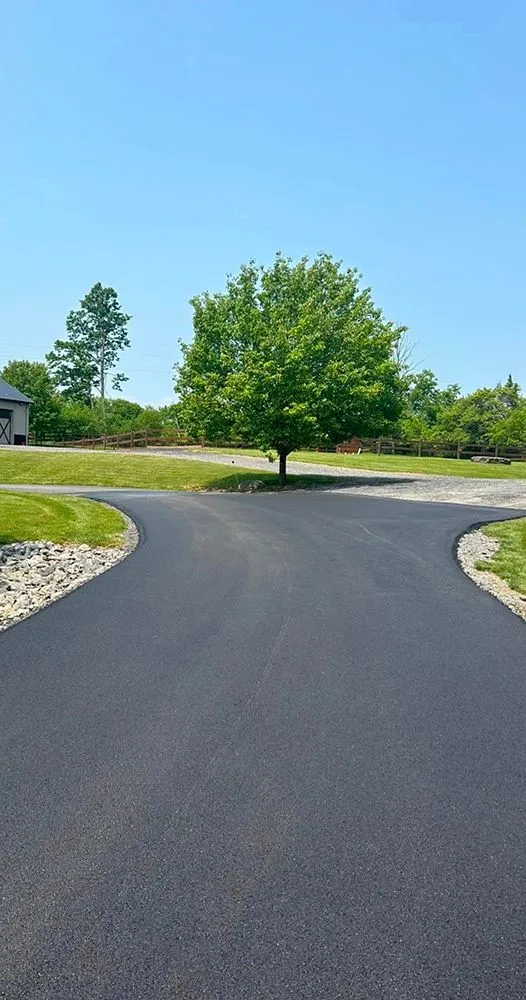
RDM Construction Companies resurfaces driveways and parking lots across Saratoga Springs and the Capital Region. We have over 40 years in asphalt, concrete, and excavation, and every overlay comes with a written 1-year workmanship and materials warranty. Before we quote, we check whether your base can actually support an overlay. If it cannot, we tell you, because an overlay on a failed base is wasted money.
If your driveway or parking lot looks rough all over but the ground under it is still solid, you probably do not need to tear it out. Resurfacing, also called an overlay, puts a new layer of hot-mix asphalt over the existing pavement. You get a new surface for a lot less than full replacement, and the job takes a day or two instead of a week.
Most driveways in this area are candidates for resurfacing well before they need replacement. If the surface is faded, cracked, and rough but the driveway is not sinking or heaving, an overlay gives you what looks and drives like a new driveway at a fraction of the tear-out cost. We fill cracks, patch failed spots, adjust the height at the garage and the road so water still runs off, and pave a new compacted layer over the top.
For commercial lots, an overlay is usually the most cost-effective way to reset the clock without shutting the property down. We work in phases so tenants and customers keep access, handle catch basin and structure adjustments so drainage still works at the new height, and re-stripe when the surface has cured. Retail plazas, office parks, and apartment complexes across the Capital Region.
Sometimes you cannot just pave over the top. If the pavement sits against curbs, garage floors, sidewalks, or doorways, raising the surface creates drainage and transition problems. In that case we mill off the top layer first, then pave the overlay back to the original height. You get a new surface without changing the grade. Our milling page covers the process in detail.
An overlay is only as good as what is under it. Before we pave, we fill cracks, saw-cut and patch failed sections, and fix soft spots in the base. Skipping this step is why some overlays crack in the same pattern as the old surface within a year or two. It is called reflective cracking, and prep work is how you prevent most of it.
If the problem is surface wear and cracking but the pavement is not sinking or moving, resurface it. If the damage sits in a few isolated spots on otherwise decent pavement, repair those spots instead, because an overlay would be overkill.
And if you have large sunken areas, spots that stay soft in spring, standing water, or pavement past 20–25 years old, replacement is the better spend, often with full-depth reclamation so the old material gets reused as the new base. We walk the pavement before we quote, and if we find base failure, we show you where it is and what it means for the price of each option.
Most bad overlays fail for one of three reasons: the base was already gone and the contractor paved over it anyway, the old surface was not cleaned and tacked so the new layer never bonded, or the cracks underneath were never filled and reflected straight through the new asphalt.
None of that is the material's fault. It is prep work that got skipped to win the job on price. We would rather lose a bid than pave over a problem we can see.
Money-Saving Offers 1-Year Work & Material Warranty Over 40 Years of Experience
We don't subcontract laborers. Our crews show up and stand behind their own work.
Licensed, insured, family and locally owned.
Price-match guarantee
40+ years in concrete, paving, and excavation across the Capital Region
1-year workmanship and material warranty
Free, no-obligation estimates
![[background image] image of construction equipment (for a construction company)](https://cdn.prod.website-files.com/69f9347c3f31317dd33a8d92/69f936cd5067b6110f83ce01_a6d7d7e9-cfc5-4490-bd34-5e75b3274e33.avif)